
By Colleen Saylor, Data Analyst, Court Improvement Program • Indiana Office of Court Services
Understanding the Process
Child welfare cases begin when the Department of Child Services investigates alleged abuse or neglect. If a child is at risk, a CHINS (Child in Need of Services) petition is filed. The case then proceeds through key milestones: adjudication, disposition, review hearings, and ultimately, permanency—whether through reunification, adoption, guardianship, or other outcomes.
Indiana tracks these stages through a set of court performance measures established in 2013. These include time-based milestones (like days to adjudication or termination of parental rights), outcome percentages, and compliance with legal timelines.
Indiana courts made meaningful progress in 2024 in moving children in CHINS and termination of parental rights (TPR) cases toward timely, stable permanency. According to the recently released federal fiscal year 2024 Court Performance Measures Report, the median time to permanency decreased by 10%—from 611 to 549 days—marking a steady trend of improvement across nearly every permanency type.
With limited exceptions, federal law requires that the Indiana Department of Child Services make reasonable efforts to reunify families.
With limited exceptions, federal law requires that the Indiana Department of Child Services make reasonable efforts to reunify families. Beginning with the Adoption Assistance and Child Welfare Act of 1980, federal policy has mandated that reunification be prioritized as the preferred permanency outcome for children who enter foster care due to abuse or neglect.
Indiana law also prioritizes family reunification. Exceptions exist, and a permanency plan beyond reunification may be required if reunification efforts are unsuccessful after a certain period of time. But the importance of parents’ rights to raise their children free of governmental involvement was recently reiterated by the General
Assembly in Senate Enrolled Act 143 (2025):
A governmental entity may not substantially burden a parent’s fundamental right to direct the: (1) upbringing; (2) religious instruction; (3) education; or (4) health care; of the parent’s child, unless the burden, as applied to the parent and the child, is required to advance a compelling governmental interest and is the least restrictive means of advancing the governmental interest.
This statutory framework reflects a clear legal expectation that child welfare systems must prioritize safe reunification with the child’s biological family whenever possible. In Indiana, reunification remains the most common outcome, occurring in over half of cases and reaching permanency in a median of 390 days.
Timely, meaningful outcomes remain a top priority for Indiana’s courts—because every day matters in a child’s life.
Timely, meaningful outcomes remain a top priority for Indiana’s courts—because every day matters in a child’s life.
The 2024 Report
The Court Performance Measures Report features a user-friendly structure that follows the life of a CHINS case, with clear timeliness measures tied to key hearings in the case. A new section compares Indiana’s performance to surrounding states and national data, offering additional context for where the state leads and where there is room for growth.
Forty-five percent of children achieved permanency within 12 months—11 points higher than the national rate.
Indiana outpaced the national average for overall time to permanency. Forty-five percent of children achieved permanency within 12 months—11 points higher than the national rate.
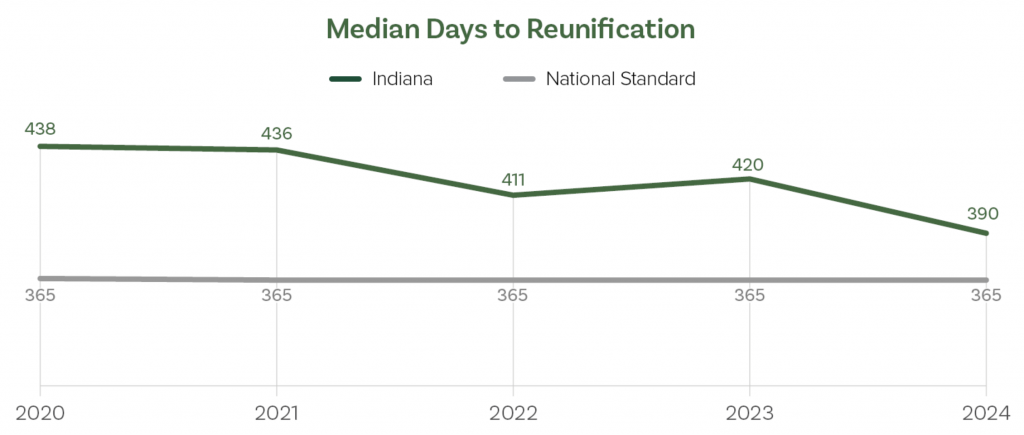
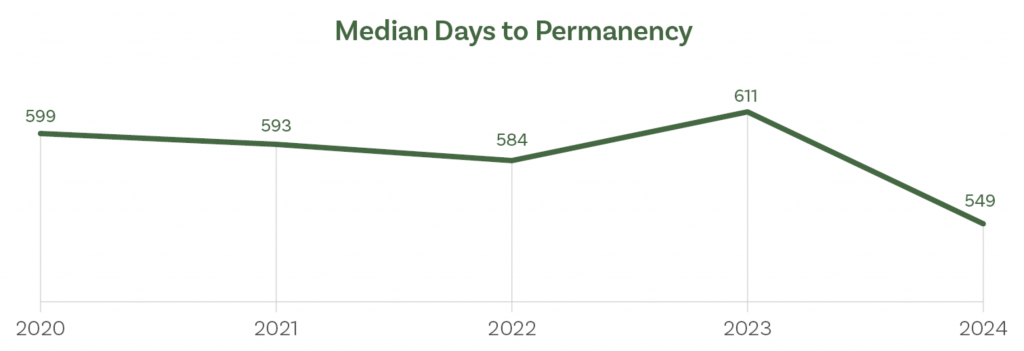

In addition to the data, the report highlights how Court Improvement Program grants are helping local courts accelerate progress. From multilingual advisement of rights videos to mediation programs and attorney support for GALs and CASAs, these initiatives are making a real difference.
CIP also continues to support judicial training and collaboration, with projects like the Quality Hearing Project. In this pilot program, trained observers attend and evaluate child welfare hearings to assess whether they are timely, focused, and legally effective. Feedback from these observations helps courts improve hearing quality and ensure that proceedings move children toward safe, permanent outcomes. CIP also provides funding for statewide conferences to share legal and legislative updates and best practices.
Comprehensive Tracking from Filing to Permanency
The Court Performance Measures—established under Indiana Administrative Rule 1(F) in 2013—track the timeliness and quality of court processes in CHINS and TPR cases. Built on a national “Toolkit” developed in 2008 by leading juvenile justice organizations, the measures assess everything from adjudication and disposition to permanency outcomes and adoption timelines. These metrics help courts meet federal and state requirements, identify improvement areas, and ultimately improve outcomes for children and families.
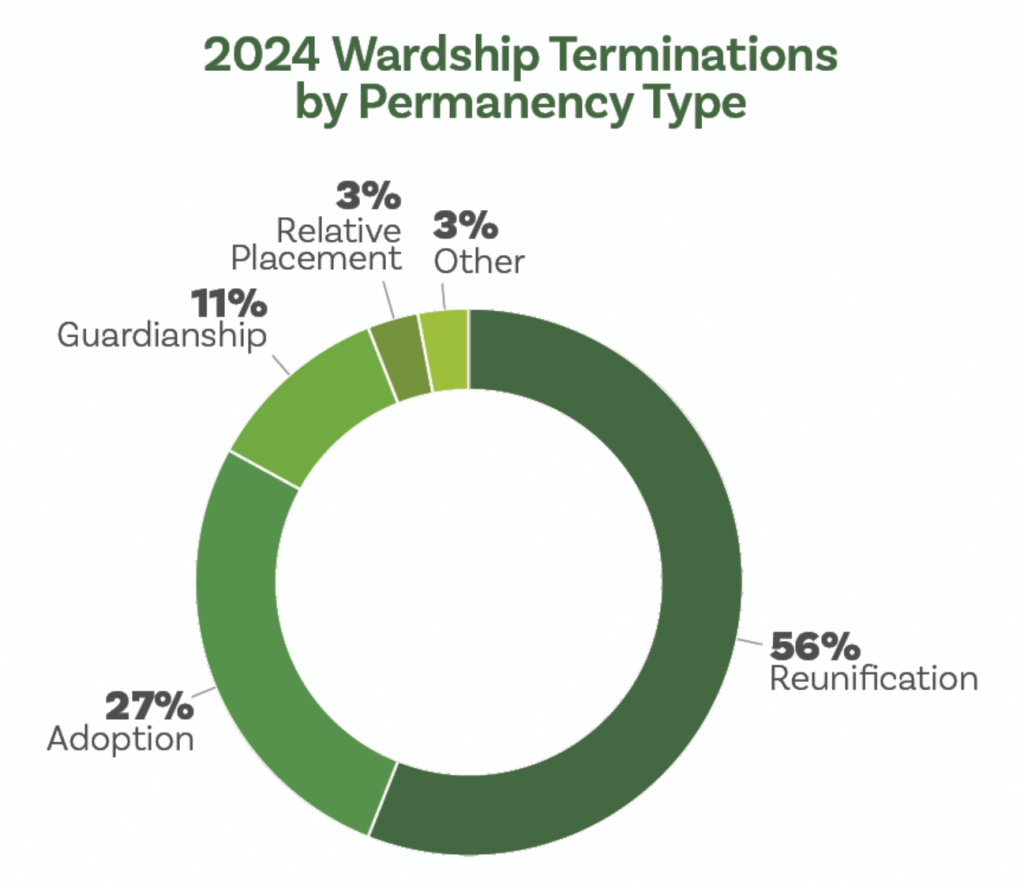
As of federal fiscal year 2025, Indiana tracks 16 performance measures, including:
- Time-Based Milestones: Time to adjudication, disposition, first review hearing, permanency hearings, TPR filings and hearings, and adoption filings and completion
- Outcome Metrics: Percentage of children reaching permanency and those who do not
- Timeliness Benchmarks: Cases completed within 90, 120, 180, or more days of critical events such as TPR or adoption petition filings
A recent update in late 2024 enhanced the accuracy of Measure 4F: Timeliness of First Review Hearing by including cases where a hearing should have occurred but did not.
Courts can further track and compare progress using the interactive Child Welfare Court Performance Measures Dashboard, which includes five years of trend data filterable by county, DCS region, and judicial district. Together, these efforts demonstrate Indiana courts’ commitment to enhancing child safety and well-being through improved efficiency, collaboration, and data transparency.