
By Kathryn Dolan, Chief Public Information Officer • Office of Communication, Education & Outreach
When Christopher Goff walked across the stage at Cameron Indoor Stadium in Durham, North Carolina to receive his LLM at Duke University, it was the first time since his high school graduation that he was handed a diploma in a formal ceremony. The kid on the stage in Wabash County 35 years earlier would go on to earn a degree summa cum laude from Ball State and a JD from Indiana University Maurer School of Law. However, none of those moments included marching in a cap and gown to pomp and circumstance. Goff explained, “When I finished college and law school, I was a young dad and husband. It seems silly now but back then, I thought I was too busy to stop and celebrate those milestones. I was always too worried about the next challenge.”
“It seems silly now but back then, I thought I was too busy to stop and celebrate those milestones.”
Class of 2025
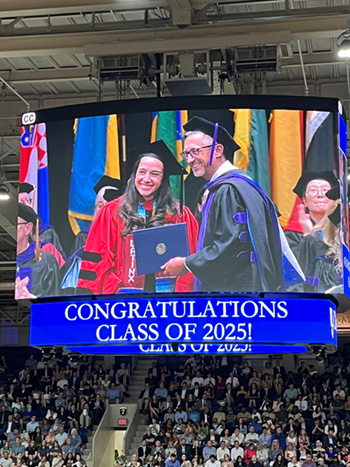
This May, the Goff cheering section included his wife of more than 30 years, Raquel, attending in person, as well as remote support from four kids and six grandkids watching Pop-Pops on live webcast. “Before the ceremony started, I gave Raquel my phone. I didn’t know they were watching me until after it was all over. It was funny to see the kids glued to the television to watch something like that. They usually need dinosaurs or Disney songs to hold their attention.”
The journey to taking part in the prestigious educational program at Duke was born out of service. Goff explained, “Judicial service is a humbling task. I’ve been a judicial officer since January 1, 2000, and it has allowed me to help my community, navigate challenges, and come out stronger. But achieving that means seeking opportunities to step outside Indiana for a minute. We need to consider what is going on outside our state and country, to hear different perspectives and historical context.”
Indiana’s Pledge to Continued Education
The opportunity to take part in formal continuing education—past law school—first came in 2016 when Goff took part in the Indiana Graduate Judge’s Program. The Indiana Office of Court Services hosts the 2-year program, which first began in 1996 under then Chief Justice Randall Shepard. The intellectually stimulating program includes graduate level coursework over a two-year period (including one week of in-person study). Since its inception, more than 300 judges have graduated. Goff enjoyed the work and his fellow classmates, “They bring in high level faculty. It helps you recharge your batteries. It made me a better judge. It allowed me to serve my community better.”
When the opportunity to take part in another formal educational program—this one focused on judicial studies—arose in 2023, Goff did not hesitate. The Duke Law Master of Judicial Studies Program (supported by an endowment to provide tuition scholarships) follows an intensive curriculum. It requires four weeks of on-site course work in two consecutive summers (a total of eight weeks on campus), plus the writing of a thesis based on original research.
“They bring in high level faculty. It helps you recharge your batteries. It made me a better judge. It allowed me to serve my community better.”
Read, Write, Review, Research, Rewrite
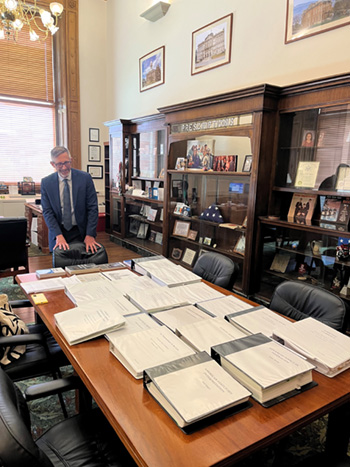
The thesis topic Goff selected centers on aligning the justice system with the behavioral healthcare system—an idea that sprung from his experiences as a trial court judge and as a member of the National Judicial Task Force to Improve State Courts’ Response to Mental Illness. “As a trial judge, I worked with others to help my community respond to the opioid crisis. We had to align our justice system with our behavioral health system. We did this by starting a drug court. Our drug court helped all our community stakeholders better understand how interdependent our work was. Everyone, in both systems, has an important role to play. Years later, through my work on the Task Force, I realized system alignment is critical in other contexts. But it takes a lot of work. Therefore, once you achieve system alignment, you should leave it in place to avoid constantly reinventing the wheel.”
In addition to problem-solving courts, communities now also have the state and local Justice Reinvestment Advisory Council. JRAC is designed to allow counties to be more responsive to community needs at the intersection of justice and behavioral health. Goff’s research concludes it takes immense work to bring everybody necessary to the table to be effective. He asserts there needs to be a permanent convening—that it is important to institutionalize the procedure. “Court systems are dealing with unique and unprecedented challenges. We are the branch that peacefully resolves conflict, so it is crucial we give our judges and stakeholders the tools to do that effectively.”
Completing the LLM program required time away from Indiana and an incredibly dense reading schedule. Goff loved it. He credits Chief Justice Loretta Rush and his Court colleagues for gracious attitudes with scheduling needs. Chief Justice Rush praised his commitment to the program. “I’m deeply grateful to Justice Goff for dedicating his time and energy to this meaningful intellectual pursuit,” said Rush. “By doing so, he follows in the footsteps of esteemed former Justices of our Court—Randall Shepard, Frank Sullivan, Jr., and Robert Rucker—who each pursued and earned an LLM as part of their ongoing commitment to learning.”
“Court systems are dealing with unique and unprecedented challenges. We are the branch that peacefully resolves conflict, so it is crucial we give our judges and stakeholders the tools to do that effectively.”
The thirst for knowledge did not surprise Goff’s wife. Raquel explained, “I absolutely thought he should do it. We both knew it would require quite a bit of work and time away from home. But I knew he would succeed. He is a life-long learner, and this was right up his alley. I enjoyed seeing his renewed passion for the law, and it reminded me of when he was in law school.”
Esteemed Colleagues
This time around, his classmates were not the newly minted undergraduates eager to make a mark on the world. The Duke cohort included impressive jurists from diverse backgrounds. With four state Supreme Court justices, nine federal court judges, and an international contingency representing Chile, South Korea, and Afghanistan, the discussions were lively. The vast experiences provided perspective. Goff explained, “Taking a look at the judicial branch and getting a more holistic view of what you do and how you interact with other branches is meaningful. This experience was an opportunity to bring good things back to Indiana.”
Further Education Opportunity for Indiana Judges
The Indiana Graduate Judge Program is available for up to 30 participants. The application becomes available in late September. The five-member program committee selects the class. Students are required to attend two consecutive summer classes in-person. For more information, contact [email protected].
Next graduate program sessions are:
- June 14-19, 2026 – French Lick
- June 13-18, 2027 – French Lick